What to Plan for Radon Control in a Charlotte Custom Home
Radon control for a custom home in Charlotte is a foundation decision, then a test, not a guess from a county color. Mecklenburg County is Zone 3 on the EPA Map of Radon Zones, a map developed in 1993, and Zone 3 is the lower-potential category, where average indoor levels may be less than 2 pCi/L [1][2]. That map is not a pass to skip testing: EPA says homes with elevated radon have been found in all three zones, and that all homes should be tested [1]. The North Carolina Radon Program lists Mecklenburg for indoor-air testing as well [3]. What has to be settled before the slab or crawl space floor closes is whether a passive soil-gas stack is in the drawings. A fan, if a later test calls for one, is added to that stack [4][8].
What the Mecklenburg zone does and does not tell you
EPA built the Map of Radon Zones in 1993 so national, state, and local groups could aim radon-resistant building codes [1]. The page is explicit about the limits. The map should not be used to determine whether a home in a given zone should be tested for radon [1]. Homes with elevated levels have been found in all three zones, and the instruction on that page is that all homes should be tested [1].
The zone labels are averages for a county, not a reading for a lot. Zone 1 is highest potential, where average indoor radon levels may be greater than 4 pCi/L. Zone 2 is moderate potential, where averages may fall between 2 and 4 pCi/L. Zone 3 is low potential, where averages may be less than 2 pCi/L [1]. The text version of the zone table that EPA publishes with the map lists Mecklenburg County, North Carolina, as Zone 3 [2]. We date that assignment because the map itself is from 1993, even though the county table is the file EPA still posts [1][2].
EPA's map page also states the action it wants after a test. Fix the home if the radon level is 4 pCi/L or higher, and consider fixing if the level is between 2 and 4 pCi/L [1]. A separate EPA page for people buying a newly built home adds a point that matters more on a single street than a county color does: radon levels can vary widely from home to home in the same neighborhood, and high levels have been found in every state [4]. The March 2024 edition of EPA's home buyer's and seller's guide says you cannot predict radon levels from state, local, or neighborhood measurements, and that a test from another home in the neighborhood is not an estimate for yours [9].
The North Carolina Radon Program's county list places Mecklenburg with the suggested action "Test Indoor Air and Private Well Water" [3]. We read that as a testing note, not as a forecast for a lot in Myers Park, SouthPark, Foxcroft, Weddington, Waxhaw, Marvin, Matthews, Mint Hill, or Ballantyne. Private well water is its own sample. This piece stays with soil gas moving into the house through the foundation. CDC's overview of radon and health says radon can build up in the air in any home or building, whether it has a basement, is sealed or drafty, or is new or old, and that there is no known safe level [17].
What North Carolina code requires, and what it leaves as a project choice
A radon system is easy to talk about as if the code already demanded it. The pages we rely on do not say that for a Mecklenburg house.
On April 7, 2025, the North Carolina Office of the State Fire Marshal said implementation of the 2024 North Carolina State Building Code had been postponed. Until the official effective date is determined, the 2018 North Carolina State Building Code remains in effect. The same statement says the 2024 code may be used as an alternative method of construction if the building owner, or the owner's agent, requests it [5]. A June 1, 2026 update from the North Carolina State Board of Examiners of Plumbing, Heating and Fire Sprinkler Contractors said the effective date had been postponed again, that approval of the Governor's nominees to the Residential Code Commission had not yet happened, and that the earliest possible date was May 1, 2027 and had not been set. Until the new codes take effect, that board's licensing exams, including the residential code, stay on the 2018 edition [15].
In the 2018 North Carolina Residential Code, Appendix F, Radon Control Methods, is marked deleted [6]. We do not turn that deletion into a claim that soil gas is irrelevant. We also do not turn the model code's radon appendix into a Charlotte requirement the county will enforce on every new slab. The deletion means the 2018 residential code does not adopt that appendix as a mandatory radon package for new one- and two-family houses [6]. That is the edition the fire marshal's April 2025 statement left in effect, and the edition the licensing board's June 1, 2026 update was still using for its residential exam [5][15].
Where the code does speak, it speaks about a system that is actually installed. In the 2024 residential code's published text, the section on subslab soil exhaust systems says that where such a system is provided, the system shall conform to that section. The ducts extend through the roof and terminate not less than 6 inches above the roof and not less than 10 feet from any operable opening or air intake, and they are permanently identified within each floor level [7]. The 2018 code's termination section, in the edition those statements left in place, uses the same clearance: through the roof, not less than 6 inches above the roof, and not less than 10 feet from any operable openings or air intake [18]. Those are installation rules for a stack you choose to build. They are not a sentence that every new house must leave the site with a fan already running.
The published 2024 residential code includes an Appendix AF whose first lines are conditional in the same way: if a sub-soil exhaust system is provided, it shall conform to the appendix, and the appendix contains requirements for new construction where radon control systems are provided [16]. We cite that text as the next published book, not as the code the fire marshal said was already mandatory in April 2025 [5]. Read that way, neither book hands us a statewide duty to install a system on a Zone 3 lot, and neither book forbids planning one. The decision still belongs in the drawings, because the parts that matter are buried or covered when the foundation closes.
Passive stack and fan: what is fixed before the pour
EPA's 2020 technical bulletin on activating a passive system draws the line cleanly. A passive system is a vertical vent pipe from a sub-slab collection pipe or mat, through the conditioned space of the house, and through the roof. The natural stack effect pulls soil gas up and out. An active system is that same pipe with an in-line fan that pulls the gas [8].
The bulletin is written for EPA's Indoor airPLUS label, which is a voluntary program, not the North Carolina code. It says radon-resistant features, including a passive system and an electrical outlet for a future fan, are required in Zone 1 if a builder wants that label. It recommends the same features in Zones 2 and 3, and it recommends that all homes be tested after construction. If the indoor level is at or above 4 pCi/L, the bulletin says a radon vent fan should be installed, regardless of the home's zone [8]. It also recommends a passive ventilation stack in all new homes, with an electric outlet in the attic near the stack, so a fan can be added if testing shows a high level [8]. Mecklenburg's Zone 3 listing means that label does not treat a Charlotte house the way it treats a Zone 1 house [2][8]. The sequence is still the practical one: build the path for soil gas while the floor is open, and decide on the fan after a test of the finished house.
EPA's page for buyers of a newly built home says to ask whether radon-resistant features were used and whether the home has been tested. It says every new home should be tested after occupancy, even when those features are already there. If the test is at 4.0 pCi/L or above, activate the system by installing an in-line fan [4]. The March 2024 buyer's guide says the same thing in construction language: even in a house built to be radon-resistant, test as soon as possible after occupancy, and if the result is 4 pCi/L or more, a vent fan can be added to the passive system to make it active [9].
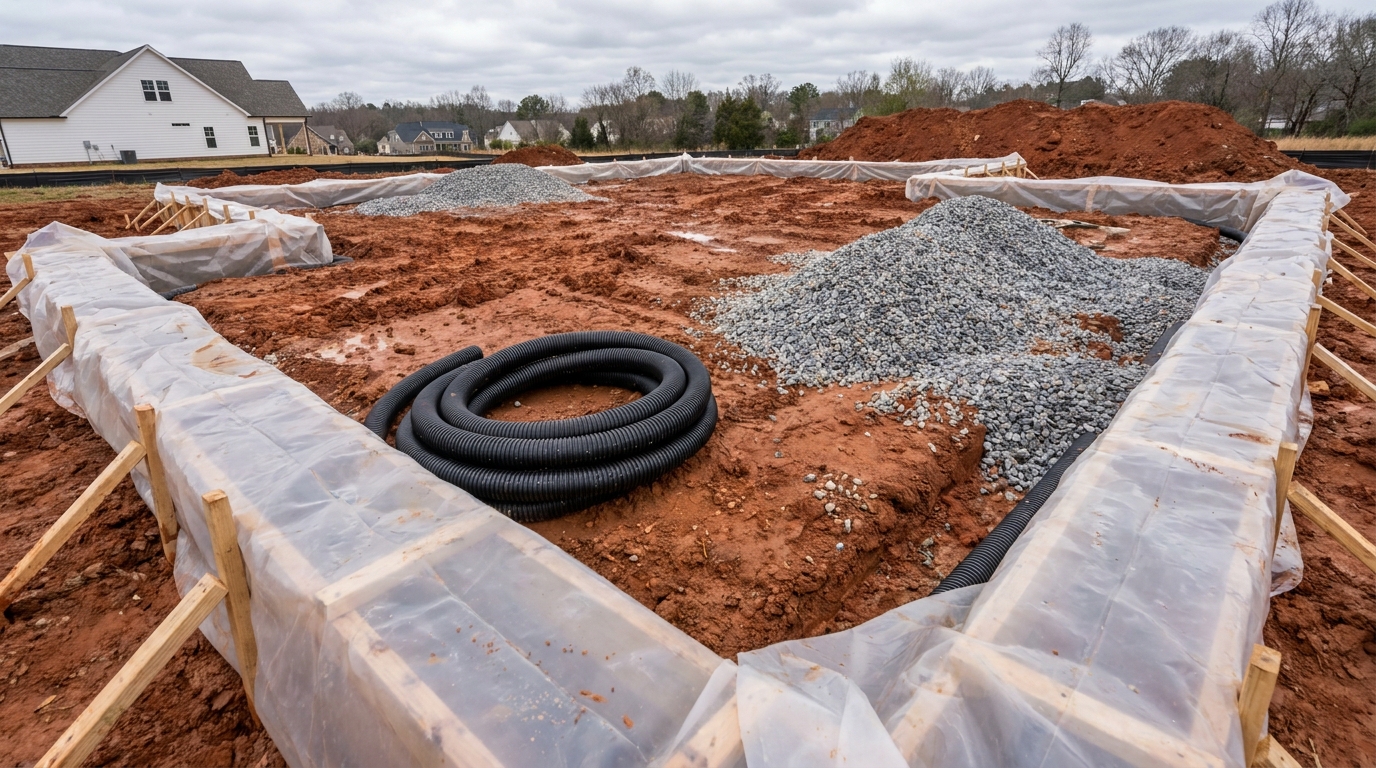
The features that have to be in place before concrete hides them are ordinary materials, which is why they belong on the foundation drawings rather than on a finish schedule. EPA describes a gas-permeable layer under the slab, in many cases a 4-inch layer of clean gravel, so soil gas can move to the pipe. The March 2024 guide limits that gravel layer to basement and slab-on-grade foundations and says it is not used under crawl space foundations [9]. Plastic sheeting goes on top of that layer and under the slab. In a crawl space, the sheeting, with seams sealed, goes directly over the crawl space floor [9]. Below-grade openings in the foundation floor are sealed. A 3- or 4-inch gas-tight pipe runs from the permeable layer through the house to the roof. An electrical junction box in the attic is there so a fan can be wired later if a test is elevated [4][9].
The 2020 bulletin adds installation habits we write into the set: run the pipe vertically through a warm part of the house, avoid treating it like a plumbing vent, label it on each floor, and keep the discharge away from openings so the gas is not pulled back inside [8]. The bulletin's roof clearance (at least 1 foot above the roof, and 10 feet from openings) is not the same number as the code section's "not less than 6 inches above the roof" [7][8]. When we install a subslab soil exhaust system, the code section that applies to that system is the one we build to. The bulletin is the picture of a passive stack and of the outlet that lets it become active later.
Sealing cracks is part of the work, and it is not the whole system. The March 2024 guide says sealing openings in the foundation is a basic part of most approaches, and that EPA does not recommend sealing alone to limit radon entry, because sealing alone has not been shown to lower levels significantly or consistently [9]. In most cases the guide describes a system with a vent pipe and a fan [9].
How a test is read, on a new house and after a change
The only number that describes a particular house is a test of that house. EPA's 2020 bulletin says local levels may vary from the county map, and that the amount of radon that will accumulate cannot be determined until the home is built [8]. CDC says there is no known safe level, and that the aim is the lowest level you can reach [11].
The North Carolina Radon Program recommends that every home be tested. Its own answer to "does a house without a basement still need a test" is yes. The list includes homes with crawl spaces and homes on a slab, along with other housing types [14]. A system already in the house is not a reason to assume the level is low. The program notes that some North Carolina systems date from the 1990s, that mitigation fans are generally warrantied for 5 years, and that the recommendation is to test at most every five years, whether or not a system is present [14].
The program's testing page lays out a short sequence, not a single canister and a guess [13]. Start with a short-term test. If the result is 4 pCi/L or higher, take a follow-up test [13]. If that first short-term result is more than twice EPA's 4 pCi/L action level, take a second short-term test immediately rather than waiting on a long-term device [13]. If the follow-up is a long-term test, fix the home when that result is 4.0 pCi/L or more [13]. If the follow-up is a second short-term test, fix the home when the average of the two tests is 4 pCi/L or higher [13]. The same page says many homes can be mitigated to 2 pCi/L or lower, and that fixing is worth considering when the level is between 2 and 4 pCi/L [13].
CDC's reduction page matches the action line: if the level is at or above 4 pCi/L, contact a qualified professional, and EPA also recommends reducing radon when the level is from 2 pCi/L through 4 pCi/L [11]. The method CDC describes as the one most used is a vent pipe and fan that pulls radon from beneath the house and vents it outside, a soil depressurization system. Sealing foundation cracks and other openings makes that kind of system more effective. Similar systems can be installed in houses with crawl spaces. The right system depends on the design of the home, including whether it has a basement [11]. After a system is installed, test again. CDC says to consider retesting every two years, and to retest after any remodeling [11].
Those intervals are not the same sentence. The 2020 EPA bulletin says to retest after the fan is activated, then every two years, or any time major renovations or alterations are made [8]. The North Carolina program says to test at most every five years, with or without a system [14]. We tell clients both, and we do not pretend the building code has collapsed them into one schedule.
When a renovation opens a slab or a crawl space
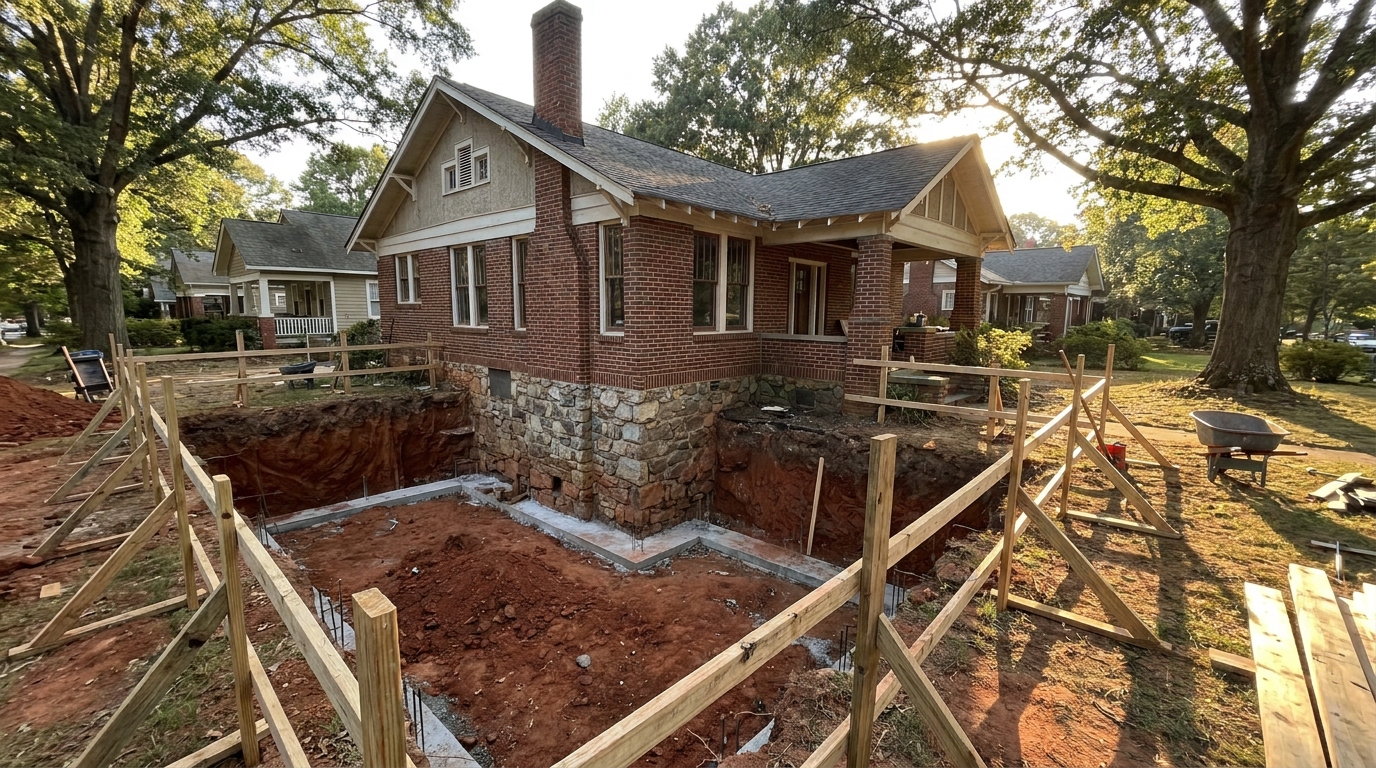
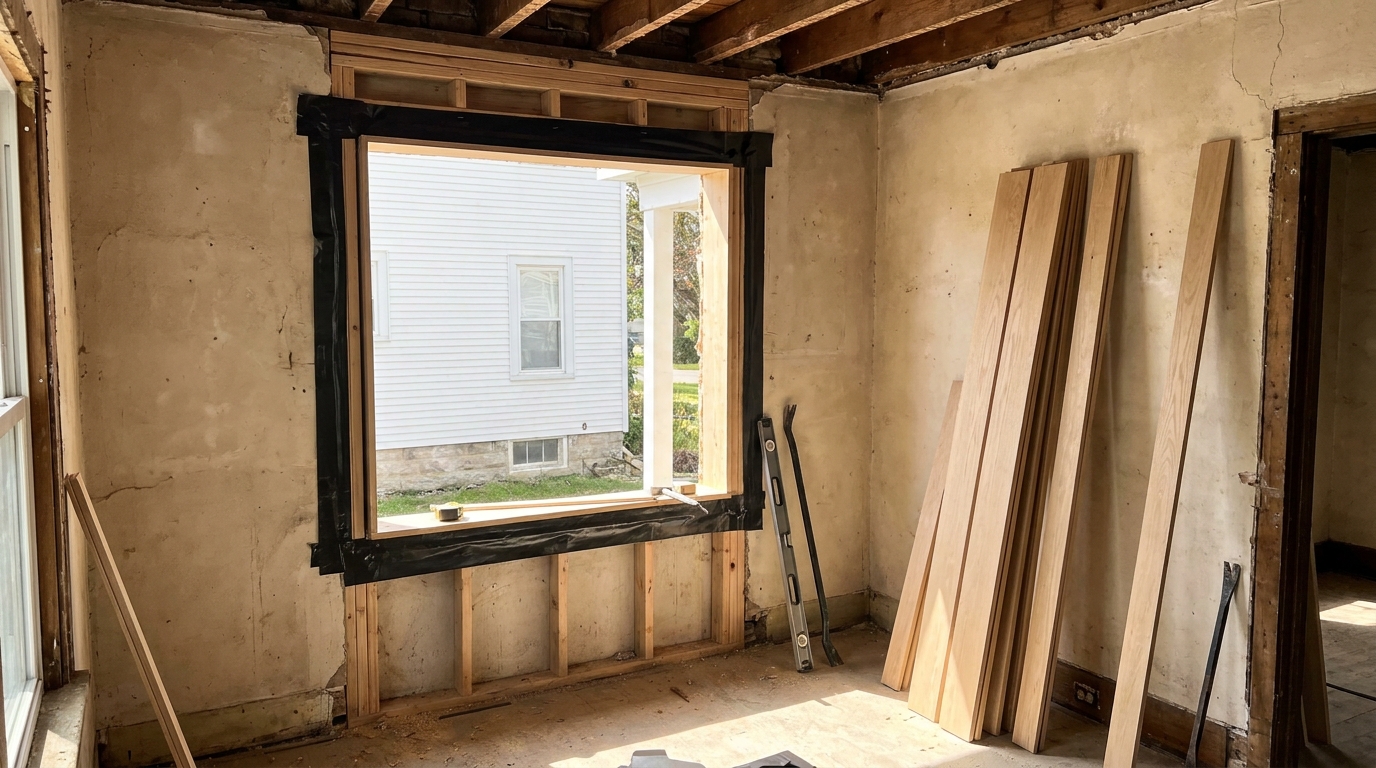
We are a building company, not only a builder of new houses. Additions and renovations open floors that a new pour never has to cut. The planning question changes with that opening, and it should be answered while the floor is still open.
EPA's Consumer's Guide to Radon Reduction, revised in December 2016, is the document we use for an existing house, and we date it because it is older than the 2024 buyer's guide. For a basement or a slab-on-grade house, the guide calls active subslab suction, also called subslab depressurization, the most common and usually the most reliable method. One or more suction pipes are inserted through the floor slab into the crushed rock or soil underneath. They may also be inserted below the slab from outside the home [10]. That is retrofit language. It assumes the concrete is already there and someone is cutting through it.
For a crawl space, the same 2016 guide says an effective method is to cover the earth floor with a high-density plastic sheet and use a vent pipe and fan to draw radon from under the sheet and vent it outdoors. It names that approach submembrane suction and says that, when properly applied, it is the most effective way to reduce radon levels in crawl space homes [10]. A less favorable option in that guide is to draw air directly from the crawl space with a fan. The guide says that technique generally does not work as well and needs special attention to combustion-appliance backdrafting and to separating the crawl space from the rest of the house [10]. CDC's overview says you can cover the earth floor in a crawl space with a high-density plastic sheet, and that a vent pipe and fan can be used to blow the radon from under the sheet and vent it outdoors [17]. We are not writing a crawl-space enclosure manual here. The only reason the crawl space is in this piece is that these pages tie it to soil gas.
CDC also lists the paths radon uses: construction joints, cavities and cracks inside walls, the sump hole or opening, cracks in floors, gaps around service pipes, and gaps in suspended floors [12]. A renovation that saw-cuts a slab, opens a crawl space, resets a sump, or adds plumbing through the floor is work on those paths. The pages do not say that every cut raises the radon number by a set amount. They do say to test again when the building changes [9][11]. The March 2024 buyer's guide says that if you finish or renovate an unfinished area, test before the project starts and again after it is finished, and that it is generally less expensive to install a reduction system before or during the renovation than afterward [9]. CDC says to retest after any remodeling [11].
Houses with more than one foundation under the same roof need more than one detail. The 2016 guide notes that a basement under part of a home and a slab-on-grade or crawl space under the rest is common, and that a combination of reduction techniques may be needed to bring the level below 4 pCi/L [10]. On an addition, we look at the new footprint on its own. A new slab can take a permeable layer and a pipe stub before the pour, which is the new-construction arrangement in the 2024 guide [9]. An existing slab that we only cut for a footing or a plumbing line is closer to the 2016 description: suction, if it is needed, means a pipe through the concrete or from outside [10]. Deciding which of those we are doing, while the floor is open, is the point of putting radon on the renovation agenda instead of discovering it after the finishes are back.
What we lock before the foundation closes
On a ground-up house, and on an addition that pours new concrete, we want these items decided before the foundation inspection, not during punch list.
First is the yes-or-no on a passive rough-in. Zone 3 and a deleted appendix do not make the answer for us [1][2][6]. The client does, with the drawings in front of them. We would rather have that conversation while the gravel and the vapor sheet are still line items than after the slab is a finished floor.
Second is which floor the system is serving. A basement or slab-on-grade gets the gas-permeable layer and the pipe connection under the concrete. A crawl space gets sheeting over the earth, not that gravel layer under a slab that is not there [9]. If one house has both, the 2016 guide's warning applies: one technique may not cover both foundation types [10].
Third is the pipe itself. Route, labels, roof termination, and distance from windows and intakes are set while walls are still open. If we are installing a subslab soil exhaust system, we follow the termination and identification rules in the residential code section written for that system [7]. We also leave the attic outlet the 2020 bulletin describes, so a fan is a later addition and not a fishing expedition through finished drywall [8].
Fourth is the test. A new house is tested after occupancy, including a house that already has the passive stack [4][9]. A renovation that finishes or alters an unfinished area is tested before the work and after it [9]. We do not treat a neighbor's result, or the 1993 county zone, as that test [1][9].
Fifth is who does the fan, if the test says one is warranted. Lowering a high level is technical work. CDC says contractors who do not specialize in radon reduction could make the problem worse, and it points owners to the state radon office or a national proficiency program for a qualified professional [11]. Our job as the builder is to leave a stack that can accept that work, and to keep the pipe from being confused with the plumbing vent.
Practical takeaways
- Mecklenburg County is Zone 3 on the 1993 EPA map, which means lower predicted average potential, not a reason to skip a test [1][2].
- The North Carolina Radon Program still lists the county for indoor-air testing, and it recommends testing every home, including slab and crawl space houses [3][14].
- The 2018 residential code marks the radon-control appendix deleted [6]. The fire marshal's April 2025 statement left that edition in effect, and the licensing board's June 1, 2026 update had still not set a 2024 effective date [5][15]. A system that is installed has termination rules in the 2018 text and, in the published 2024 text, identification rules as well [7][18].
- A passive stack and an attic outlet are the parts to draw before the foundation closes. The fan is added if a post-occupancy test is at or above 4 pCi/L [4][8].
- A renovation that opens a slab or a crawl space is the time to place a collection layer or a membrane, and the time to test before the work and again when it is finished [9][10][11].
- Sealing cracks helps a system. It is not a substitute for the vent, and a neighbor's test is not your number [9].
How we can help
Everett Custom Homes plans the floor, the pipe route, and the test with the rest of the construction set, whether the project is a new house on your lot or a renovation or addition that opens an existing slab or crawl space. Each ground-up house is individually designed, and our owner is on site through construction, so a soil-gas decision does not get lost between the architect's sheets and the pour. If you want that conversation before a foundation is closed, start with our process or schedule a consultation.
Citations
- U.S. Environmental Protection Agency, "EPA Map of Radon Zones" (map developed 1993; page current)
- U.S. Environmental Protection Agency, "Radon Zones (JSON) text version" (June 2024 file of the zone table)
- N.C. Department of Health and Human Services, "County Testing and Mitigation Recommendations" (2026)
- U.S. Environmental Protection Agency, "How to Protect Your Family from Radon When Buying a Newly Built Home" (page current)
- N.C. Office of the State Fire Marshal, "North Carolina Delays Implementation of 2024 State Building Code" (2025-04-07)
- International Code Council, "2018 North Carolina State Building Code: Residential Code, Appendix F Radon Control Methods" (2018 code)
- International Code Council, "2024 North Carolina State Building Code: Residential Code, Chapter 15 Exhaust Systems, Section M1508" (published 2024 code text)
- U.S. Environmental Protection Agency, "Technical bulletin on activating a passive radon system, EPA 402/B-20/007" (2020)
- U.S. Environmental Protection Agency, "Home Buyer's and Seller's Guide to Radon, EPA 402/K-24/001" (March 2024, revised)
- U.S. Environmental Protection Agency, "Consumer's Guide to Radon Reduction" (revised December 2016)
- Centers for Disease Control and Prevention, "Reducing Radon Levels in Your Home" (2026-06-18)
- Centers for Disease Control and Prevention, "How Radon Gets Into Your Home" (updated 2026-08-26)
- N.C. Department of Health and Human Services, "Testing for Radon" (2026)
- N.C. Department of Health and Human Services, "North Carolina Radon Program" (2026)
- N.C. State Board of Examiners of Plumbing, Heating and Fire Sprinkler Contractors, "Update on New North Carolina State Building Code Effective Dates" (2026-06-01)
- International Code Council, "2024 North Carolina State Building Code: Residential Code, Appendix AF Radon Control Methods" (published 2024 code text)
- Centers for Disease Control and Prevention, "Radon and Your Health" (updated 2026)
- International Code Council, "2018 North Carolina State Building Code: Residential Code, Section M1508.4 Termination" (2018 code)