Seven Questions That Reveal Construction Quality When You Hire a Custom Home Builder in Waxhaw
Construction quality shows up in the proposal and on an open job long before it shows up in a finished room. Seven questions will tell you whether Waxhaw custom home construction quality is being managed: who is on the job, who meets the inspector, how an allowance becomes a specification, how concealed work is recorded before it is covered, what a comparable reference really is, how changes and code corrections are priced, and what the contract says about responsibility. A useful answer names a person, a document, and a consequence. A vague answer is information too, and it is better heard before you sign.
Who will be on the job, and who holds the license
As amended in 2023, North Carolina law treats a person or firm as a general contractor when, for a fixed price, commission, fee, or wage, that person undertakes to construct a building, or to superintend or manage the work, and the cost of the undertaking is $40,000 or more [1]. Whether a particular addition or renovation crosses that line depends on the contract amount, not on the project label.
The license and the daily lead are two different facts. The qualifier is the individual who passed the licensing examination on reading plans and specifications, the State Building Code, estimating, ethics, and the contractor's legal duties, including lien law [3]. If that qualifier leaves the firm, the license remains in force for 90 days and then is invalidated, and during that window the firm may not bid on or undertake additional contracts until the license is reinstated [3]. A license also expires on the first day of January after it is issued or renewed and, unless renewed, becomes invalid 60 days later [3]. Ask for the license number, the qualifier's name, and whether that qualifier is still with the company. Then ask who will actually be on your lot.
Project limits are printed into the license classes. The General Assembly's text of the licensing statute, with amendments through 2024, gives an unlimited license no single-project value cap [3]. An intermediate license covers any single project up to $1,500,000, and a limited license covers any single project up to $750,000, in each case excluding the cost of land and any ancillary costs to improve the land [3]. The same statute separates a building classification, which includes residential buildings among other types, from a residential classification limited to residences that must follow the North Carolina Residential Code [3]. Match the classification and the dollar limit to the construction contract in front of you. Land price does not count toward that cap, and it does not excuse a license that is too small for the house.
The inspector will not fill the gap. In an April 20, 2026 formal interpretation, the Office of the State Fire Marshal quotes the commentary to the 2018 North Carolina Administrative Code and Policies: the code official verifies compliance at specified inspections and is not on site at all times while construction is underway [4]. Daily control is the builder's obligation. A useful answer on a proposal sounds like this. Here is the license. Here is the person who will be on this site, who that person reports to, and whether that person can stop a trade or approve a field change. On the walk, ask the person beside you who ordered the last correction, and whether they can show you the note.
On our projects, our owner, Eric Brown, makes daily site visits during construction. Our process page describes that practice, along with on-site milestone meetings. Daily visits are one way to answer the question. They are not a substitute for a current license, a named site lead, or written authority to correct work.
Who attends the inspection, and who fixes a failure
The same April 20, 2026 interpretation sets out eight routine inspections under the 2018 administrative code: footing; under-slab, as appropriate; foundation; rough-in; building framing; insulation; fire protection; and final [4]. It is the permit holder's duty, or the duty of the permit holder's agent, to notify the official when the work is ready and to provide access [4]. The official tells the permit holder where the work fails the technical codes. Work that does not comply has to be corrected, and it is not to be covered or concealed until the code enforcement official authorizes it [4]. Work also is not supposed to proceed past the point of each successive inspection without that approval [4].
Two limits belong in the same conversation, because a useful answer does not promise inspections the law does not require. The interpretation concludes that an inspections department is not required to break one of those routine inspections into a partial, single-trade visit merely because one trade finished early [4]. Separately, the statute quoted in that letter provides that a local government may not require routine exterior sheathing inspections where the ultimate wind speed is less than 140 miles per hour, unless the Residential Code Council has approved the extra inspection [4]. Items that are not visible at the framing inspection, including nailing of roof or wall sheathing, remain the permit holder's responsibility [4]. Ask which of the eight inspections this house will actually receive. Ask whether anyone will see the shear-wall and roof nailing before it disappears, and if the answer is no, ask who photographs it.
Do not guess the permit office from a Waxhaw mailing address. As amended in 2023, the permit statute speaks to the building inspector or other authority of the incorporated city, town, or county that is charged with issuing the permit [2]. Confirm that office yourself before you rely on a builder's description of "the county" or "the town." A mailing address is not a jurisdiction.
A useful answer names the permit holder, the person who will meet the inspector, and the person who corrects a failed item before the wall is closed. It separates a failed inspection from a request the office is allowed to decline. If a proposal asks you to pull the permit as an owner-builder, read the affidavit before you agree. For a permit on work costing $40,000 or more, an owner claiming the statutory exemption must swear to personally superintend and manage the construction, without delegating that duty to an unlicensed person, and must be personally present for the inspections required by the State Building Code unless the plans were drawn and sealed by an architect licensed in North Carolina [2]. The inspection statute, as quoted in the April 20, 2026 letter, says an inspection is not conducted without that owner present unless the same architect-sealed condition is met [4]. Hiring a builder and then carrying the permit yourself is not a paperwork shortcut. It is a different set of duties.
How an allowance becomes a specification
The Federal Trade Commission's 2014 brochure, Hiring a Contractor, says a written contract should list materials by color, model, size, and brand where those choices are already known [7]. Where a material will be chosen later, the same 2014 brochure says the contract should state who chooses it and how much money is budgeted [7]. That budget is the allowance [7].
An allowance is a number waiting for a product. A specification is the product the trade is told to install. On a Waxhaw proposal, ask which lines are still allowances, who selects them, by what date, and whether labor, delivery, and installation sit inside the allowance or in the base contract. Ask what happens to the price if the selection costs more than the budget, and what happens if it costs less. The 2014 brochure treats a later change to the work as a change order: a written authorization that can move both cost and schedule [7]. The overage should be that kind of writing, signed before the item is ordered, not a surprise on a draw.
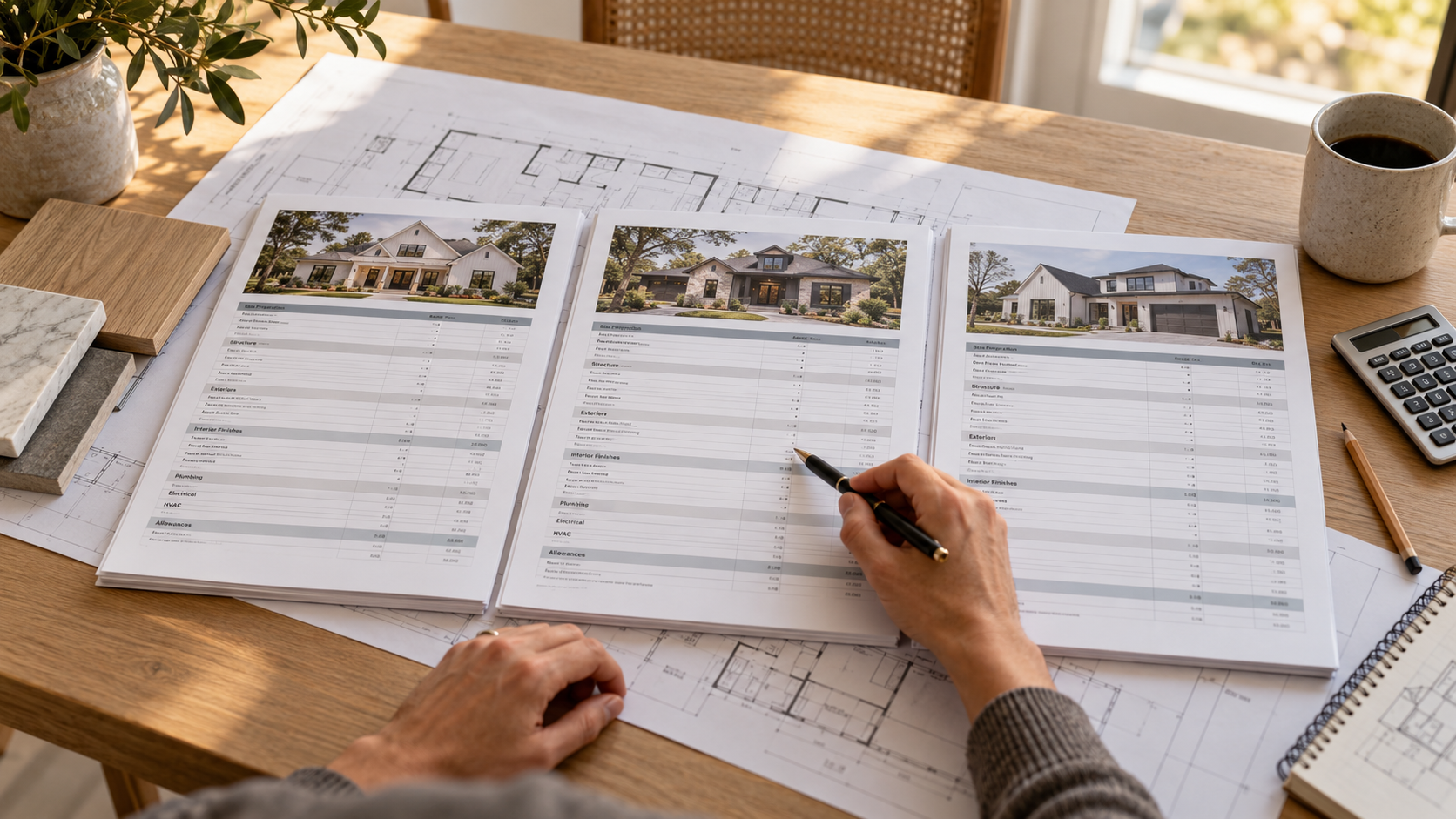
Finishes are often still open when a custom contract is signed. In our work, specification development starts during design and budgeting, and many remaining selections are finalized with suppliers when the contract and the schedule are set. That sequence is only as good as the clause that converts each allowance into a named product. A useful answer shows the allowance schedule and the credit-or-charge rule. "We will work it out in the field" means the number on the proposal is not yet a price for a defined house, addition, or renovation.
How concealed work is documented before it is covered
The legal floor is the inspection rule already noted. Noncompliant work is corrected, and it is not covered until the official authorizes the cover [4]. That rule still leaves a great deal unseen. The code official is not on the job every day, and some items are not visible even at the inspection that comes closest [4]. Waxhaw custom home construction quality, on a new house or an addition, depends on what the builder records in that gap.
One concealed condition is spelled out in a June 3, 2026 interpretation from the Office of the State Fire Marshal, written against the 2018 Residential Code [6]. When a deck is attached to a house, the appendix provision quoted there requires a treated wood band for the length of the deck, or corrosion-resistant flashing, so moisture does not reach untreated framing [6]. If no treated band is present, the interpretation says non-aluminum flashing is required [6]. If the band is treated and siding continues below it, flashing and a kick-out are still required [6]. If pressure-treated sheathing meeting the code section cited in that letter completely covers an untreated band, flashing is not required, unless siding sits underneath, in which case flashing and a kick-out remain mandatory [6]. The stated intent is to keep water off the framing and to satisfy the water-resistive barrier requirement [6]. On a walk, stand at a deck ledger or a porch connection and ask to see that condition, or a dated photograph of it, before trim and siding close the joint. Ask the same kind of question at a roof-to-wall intersection and at the insulation, and ask which code edition the permit office is enforcing on this lot. Both of the 2026 letters we rely on here are written against the 2018 code [4] [6]. Your permit may say something you should read for yourself.
If the contract includes ENERGY STAR certification, the standard is stricter and it is a program rule, not a statement that every local permit requires it. The Environmental Protection Agency's May 1, 2023 technical bulletin says a pre-drywall inspection is always required for that certification, because the agency found no substitute that gives the same certainty [5]. If drywall is installed first, the bulletin says the drywall that conceals the rated items has to come off so the rater can see them. Opening a few holes is not enough [5]. The bulletin's examples of what that visit is meant to catch include a missing air barrier behind a tub, a knee wall left uninsulated, and an HVAC chase left unsealed [5]. North Carolina's insulation inspection is a separate hold point on the routine list [4]. The habit we want is the same either way. What must be seen is seen, noted, and, if it failed, corrected before it is covered.
The 2014 FTC brochure suggests that an owner keep a project log and photograph the work as it proceeds [7]. Ask the builder for the set the builder already keeps: date, location in the house, and what the frame shows, shared before drywall or cladding. A useful answer is a folder you can open on the walk. A promise to take pictures later, after the walls are closed, is not a record of concealed work.
What counts as a comparable reference
In that 2014 brochure, the Federal Trade Commission says a contractor should be able to give names, addresses, and phone numbers of at least three clients with projects like yours, and that you may ask to visit work still in progress [7]. The phrase that matters is "like yours."
A finished new house is a weak reference for a renovation, and it is only a partial reference for an addition. An addition has to join an existing structure, an existing roof, and usually an existing mechanical system. A renovation opens assemblies nobody has looked at in years. We build new houses on an owner's lot, and we also renovate and add on, because those are different kinds of construction rather than a lesser version of a new house. If you are hiring for one of them, ask for a reference of that type. Ask whether you can walk a job that is still open at framing or insulation, not only a completed room. Ask those clients who was on site, what an inspector rejected, and how a change was priced. The 2014 brochure also suggests asking whether the work finished on time and whether costs showed up that the owner did not expect [7].
On your own walk of a builder's open job, look for the same evidence the questions ask about. Is a current plan set available. Does the person on site know which inspection is next. Can they show a correction that was made, or a photograph of flashing and insulation that is about to disappear. Courtesy and a clean jobsite matter, but they are not a substitute for that record.
How change orders and code corrections are priced
A failed inspection and an owner change are not the same event, and they should not be priced as if they were. The administrative code, as quoted in the April 20, 2026 interpretation, requires noncompliant work to be corrected and left uncovered until the official authorizes it [4]. The code text quoted there does not assign the dollar cost. The contract has to.
Ask the builder to sort changes into three written buckets. The first is work the builder installed that does not match the approved plans or the code the builder was hired to meet. The second is a change you direct after signing, including a selection that spends more than its allowance. The third is a condition in an existing house that neither party could see until demolition, which is ordinary in renovations and additions and uncommon on a cleared lot. The 2014 brochure's change order, a written authorization to change the original scope, with an effect on cost and schedule, fits the second bucket, and the same writing should be adapted for the third before extra work proceeds [7].
A useful answer does not hide code corrections inside an unnamed contingency, and it does not treat your allowance overage as something the builder will absorb without a rule. It also does not pretend that every hidden condition in an older Waxhaw-area house was included in the base price. You should see the price and the time effect before the extra work starts.
Payment timing belongs in the same discussion. The Federal Trade Commission's July 2022 article on home-improvement scams says not to pay the full price up front, and not to make the final payment until the work is finished and you are satisfied with it [8]. The article notes that some states limit down payments and tells you to check the rule where you live, rather than assuming a national cap [8]. Ask what this contract requires at signing, at each inspection milestone, and at the end, and ask what you may withhold if a listed inspection has not been approved.
What the written contract says about responsibility
North Carolina's building-permit statute, with amendments through 2024, says that, apart from stated exceptions, no person may start construction, reconstruction, alteration, or repair of a building without the permits required by the State Building Code and other applicable state or local laws [9]. The exceptions we read are narrow. They include, for example, certain water-heater replacements and certain lighting-device replacements in a one- or two-family home when a licensed trade does the work under conditions the statute lists [9]. Those exceptions are not a custom home, a renovation, or an addition. The July 2022 FTC article treats a contractor who tells you to pull the permits yourself as a warning sign [8]. The 2014 brochure puts the opposite duty in the contract: the contractor obtains the permits the project needs [7].
The permit counter enforces a parallel rule. As amended in 2023, for work costing $40,000 or more, the applicant must show that the applicant, or another person contracted to superintend or manage the construction, is licensed under the general-contractor statute, or must qualify for an exemption, and must show the workers' compensation coverage that Chapter 97 requires [2]. The statute makes it unlawful for the permit official to issue the permit until that evidence is in hand [2]. Ask to see the license and the insurance certificates that will be shown at that counter, and ask who will be named as the permit holder.
Then put the operating rules in the contract rather than in a meeting. The 2014 brochure's checklist is a sound minimum, and because the brochure is more than a decade old it is a checklist, not a complete statement of today's North Carolina law [7]. It calls for the contractor's name, address, phone, and license number; an estimated start and completion; the payment schedule; the obligation to obtain permits; how change orders are handled; a budget and a decision-maker for items not yet chosen; warranties, including who honors them and for how long; and a statement of what the contractor will not do, such as whether site cleanup is included [7]. The brochure also says promises made in conversation should be written down, because otherwise you may be charged extra later [7]. The July 2022 article adds that the contract should include those conversation promises about scope and about the cost of labor and materials, and a written notice of any three-business-day cancellation right that applies if you signed away from the seller's permanent place of business [8]. That cancellation sentence is the FTC's description of when to look for the notice. It is not a reason to skip reading the contract you are actually offered.
Before the last payment, ask for lien waivers or releases from the contractor and from subcontractors and suppliers. The 2014 brochure warns that unpaid parties may be able to file a lien under state law, and it tells the owner to ask for releases rather than assuming the final check closed every account [7]. We are not stating a deadline or a form under North Carolina's lien statutes here. We are stating the question the contract should answer: who signs the releases, and which payments wait for them.
A useful answer to this last question is a contract you can mark. Who holds the permit. Who calls inspections and who corrects failures. Which license covers this contract amount. How allowances close. How the three change buckets are priced. What photographs and reports you receive before concealed work is covered. This is a field checklist for a proposal and a jobsite walk, not a legal opinion. If the paper is unclear on responsibility, have your own lawyer read it before you treat the price as firm.
Practical takeaways
- Ask for the license number, classification, project limit, qualifier, and renewal status, then ask for the name of the person who will be on the lot and what that person is allowed to stop or approve.
- Ask who the permit holder is, who will attend each inspection, and who corrects a failure before the work is covered. Confirm yourself which city, town, or county office issues the permit. A Waxhaw mailing address does not answer that.
- Treat every allowance as unfinished until the contract names the product, the selector, the deadline, and the credit or charge if the cost moves.
- Ask for dated photographs of flashing, structure, and insulation before cover, and do not accept drywall or cladding over work that the required inspection has not approved. If ENERGY STAR is in the contract, the May 1, 2023 federal bulletin says the pre-drywall inspection is not optional for that certification [5].
- Ask for references of the same kind of work you are buying. A new house is not a comparable reference for a renovation or an addition, and a finished room is a weaker reference than a job still open.
- Sort extra cost into code corrections, owner-directed changes, and concealed conditions in an existing house. Price the second and third in writing before the work proceeds.
- Read the contract for permits, insurance, change orders, warranties, cleanup, payment milestones, and lien releases. Conversation is not the contract.
How we can help
If you are comparing builders for a new house, an addition, or a renovation, bring the proposal and these questions. We will walk through who will be on the lot, how inspections, allowances, and concealed work are handled, and what the contract will say about responsibility, without treating a mailing address as a permit jurisdiction. Waxhaw custom home construction quality is a set of answers you can check, on paper and on a job that is still open. Start that conversation on our contact page.
Citations
- North Carolina General Assembly, "G.S. 87-1. General contractor defined; exceptions" (2023)
- North Carolina General Assembly, "G.S. 87-14. Regulations as to issue of building permits" (2023)
- North Carolina General Assembly, "G.S. 87-10. Application for license; examination; certificate; renewal" (2024)
- North Carolina Office of the State Fire Marshal, "2018 NC Administrative Code and Policies, Section 107 Inspections" (2026-04-20)
- U.S. Environmental Protection Agency, ENERGY STAR, "Technical Bulletin: Pre-Drywall Inspection Is Always Required" (2023-05-01)
- North Carolina Office of the State Fire Marshal, "Application of Figure AM 103.1" (2026-06-03)
- Federal Trade Commission, "Hiring a Contractor" (2014)
- Federal Trade Commission, "How To Avoid a Home Improvement Scam" (2022-07)
- North Carolina General Assembly, "G.S. 160D-1110. Building permits" (2024)